Norra CRM
Solutions
How Norra CRM serves new prop firm launches, established evaluation firms, scaling teams and multi-brand operators.
For teams preparing to launch
Launch on rails, not on spreadsheets
- Stitching together CRM, payments, KYC and risk tools before revenue exists
- No idea if the challenge economics actually work
- Two founders doing support at midnight
The whole back office on day one
Products, purchases, KYC, risk rules, payouts, support and books run on one platform from the first sale — configured, not integrated.
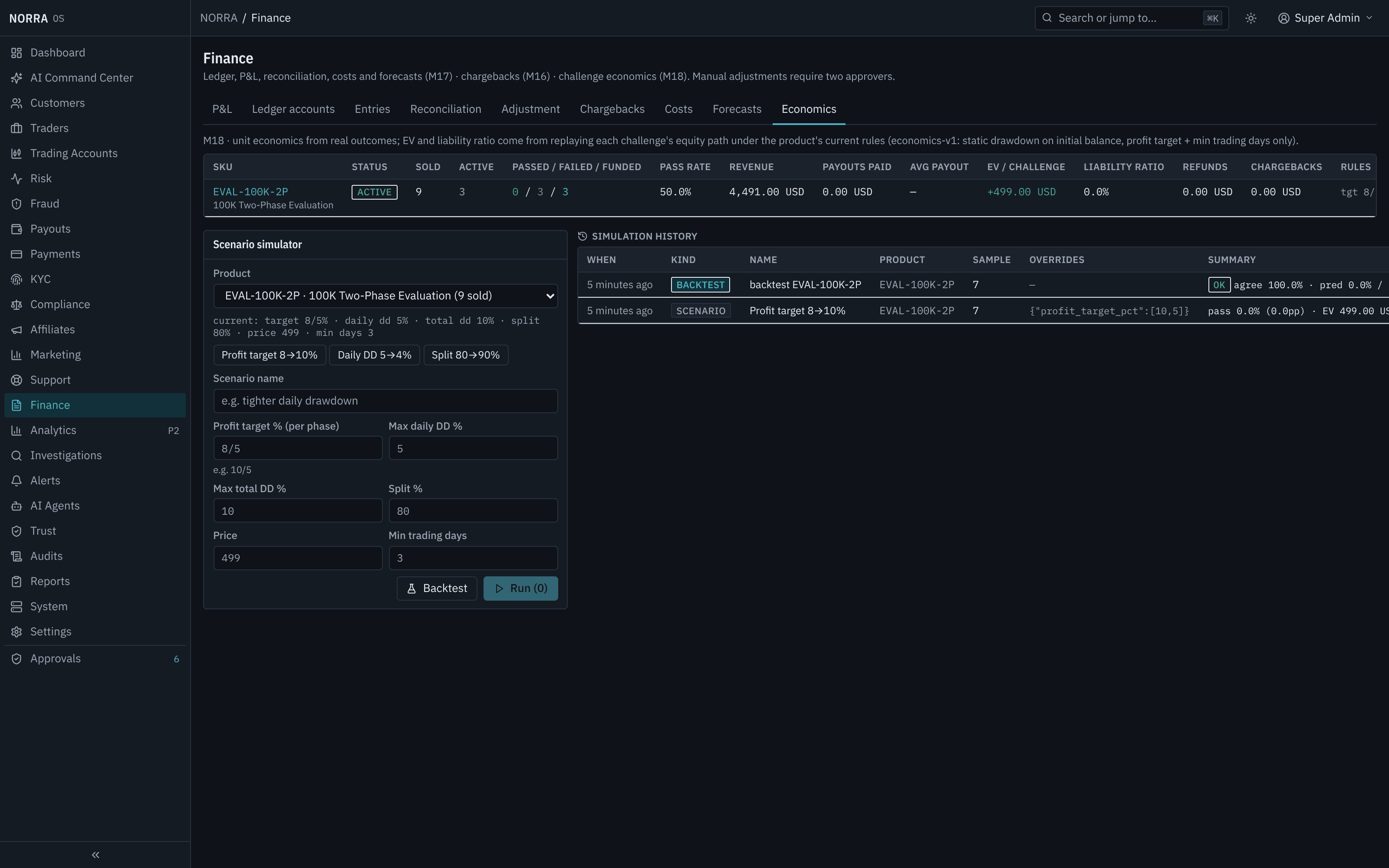
Price the product before you sell it
The economics simulator models pass rates, payout liability and EV per challenge under your exact rules — and keeps backtesting once real data arrives.
Skip the spreadsheet era entirely
The audit trail, the ledger and the approval discipline that firms usually bolt on in year two are the default here.
Outcome
A two-person team launches with the operational posture of a firm ten times its size.
For established firms (500–10,000 traders)
Kill the payout–support–KYC backlog
- First payouts take one to three weeks of manual review
- Support volume scales linearly with traders; headcount follows
- Risk review happens in spreadsheets, after the fact
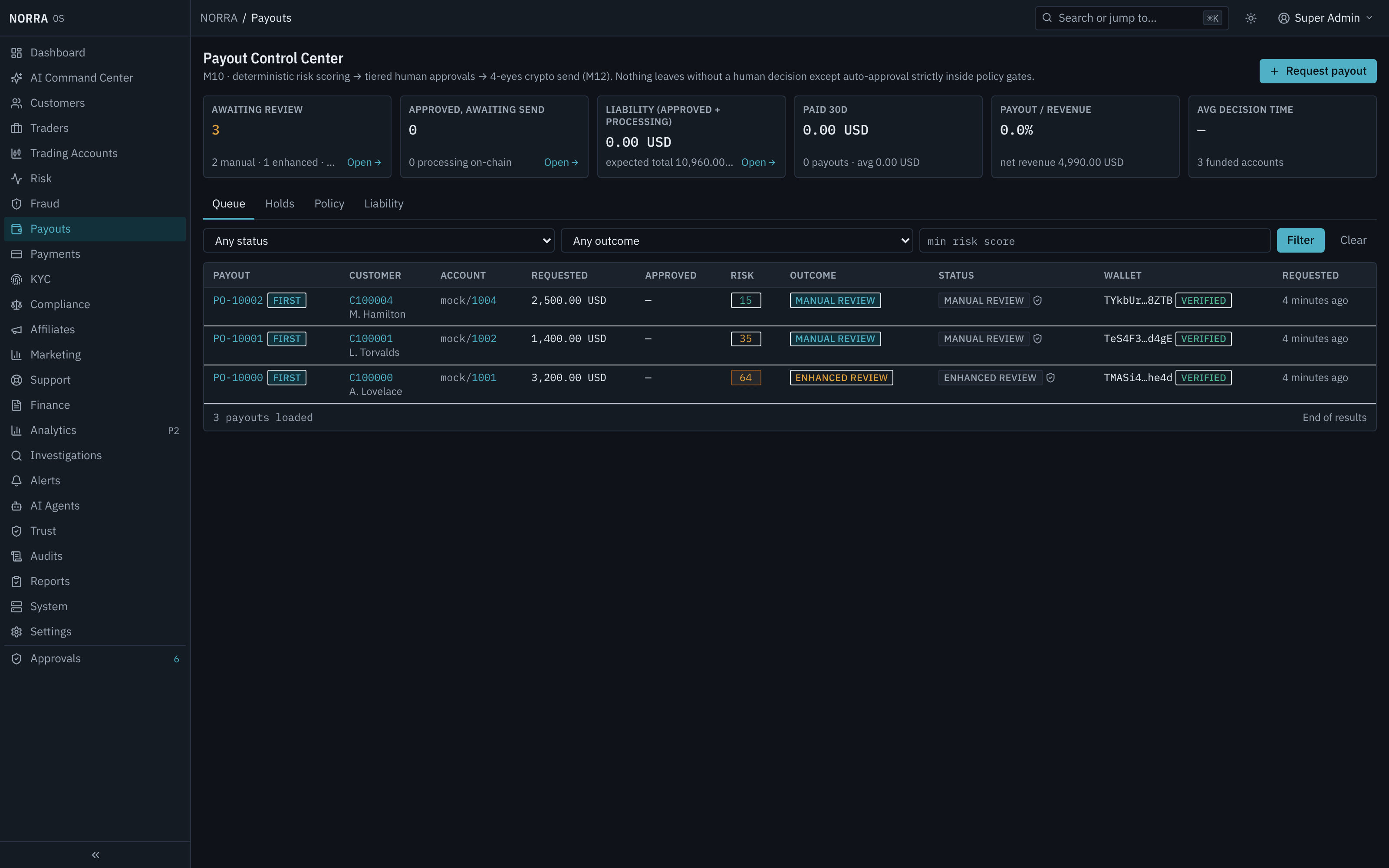
Payout triage that explains itself
Every request arrives scored and explained, with blockers resolved or surfaced. Your team reviews decisions, not raw data. Clean repeat payouts auto-approve inside the caps you set.
Tier-1 support, drafted
The three questions that dominate your queue — payout status, KYC gaps, breach explanations — arrive with accurate drafts attached. Humans approve; nothing sends itself without a policy you signed.
Fraud that surfaces before the payout
Clusters, similarity and wallet reuse are detected continuously, so the risk shows up in the payout score — not in a post-mortem.
Outcome
Payout cycle time, first-response time and queue depth become dashboard numbers that go down — with an audit trail for every decision.
For growing firms
Scale volume without scaling headcount
- Every 1,000 new traders used to mean two new ops hires
- Tool sprawl: six dashboards, none agreeing with each other
- Founders still personally approve everything
Automation with approval discipline
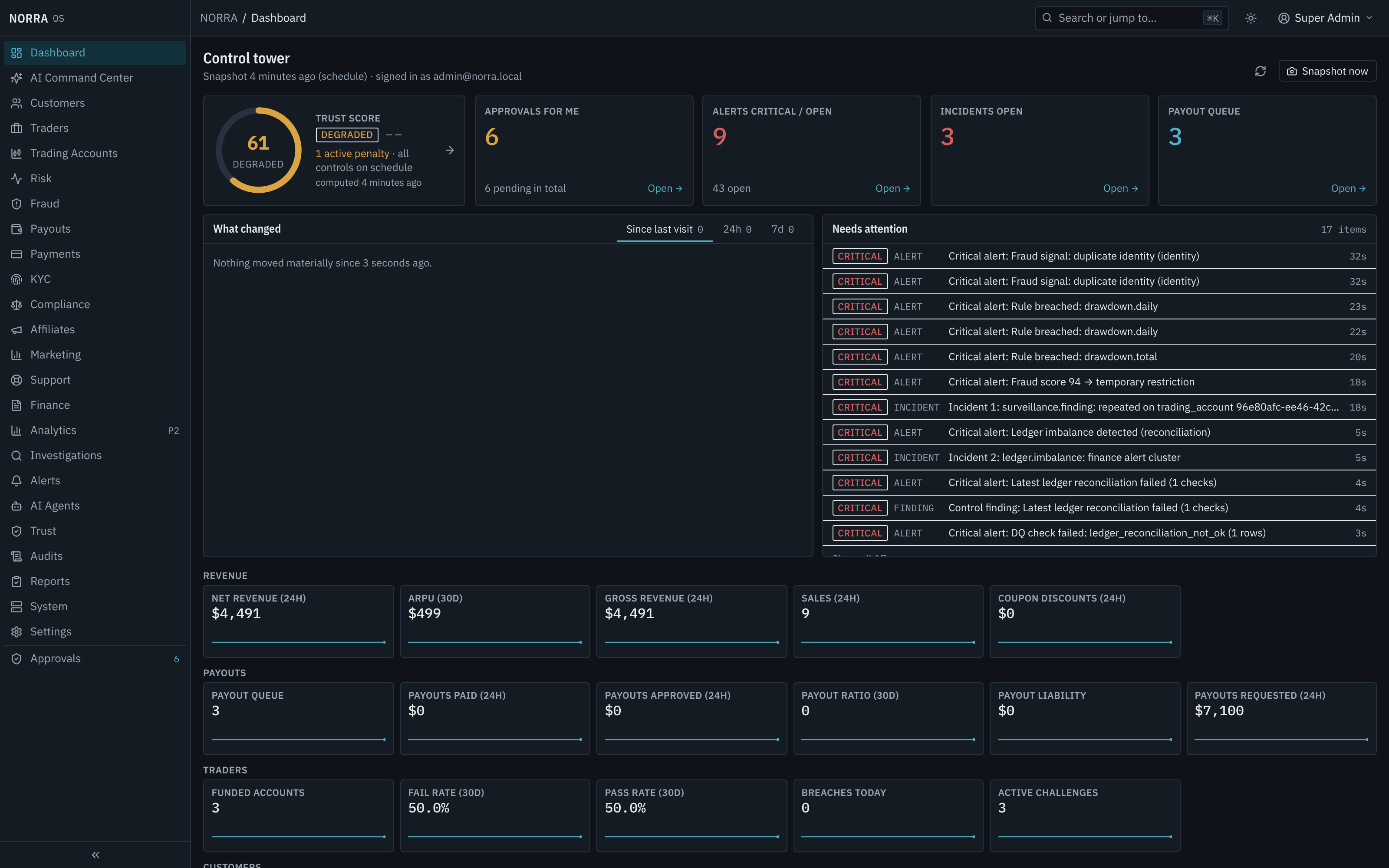
Routine work flows through agents and policies; judgment calls flow through tiered approvals. A three-person ops team stays effective at multiples of today’s volume.
One source of truth
Risk, fraud, finance and support read the same data. When support answers a payout question, it cites the payout module — not a stale export.
Delegation you can audit
Granular permissions with amount caps let founders hand off approvals without handing off control. Every decision keeps its decision-maker.
For multi-brand operators
Many brands. One control plane.
- Each brand runs its own stack, team and books
- Risk and fraud can’t see across brands — but the fraudsters work across brands
- Consolidated reporting is a monthly spreadsheet project
Per-product economics, shared infrastructure
Every product line keeps its own rules, pricing and funnel while sharing one ledger, one risk engine and one compliance layer.
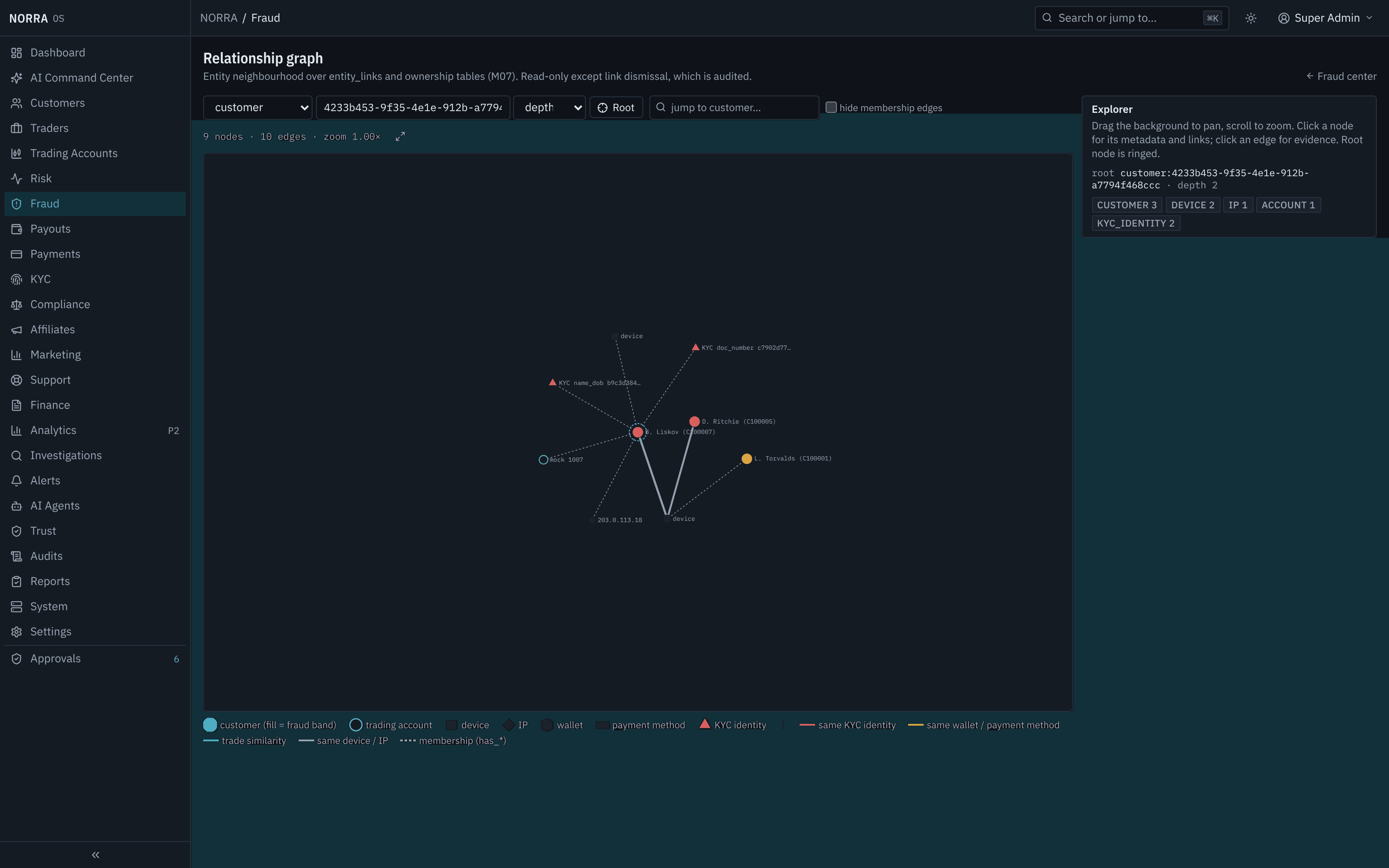
Cross-brand fraud visibility
Device, wallet and identity links don’t stop at brand boundaries. A farm hitting three of your brands is one cluster, not three mysteries.
Consolidated finance, instantly
P&L, payout liability and cash requirements roll up across the portfolio because they were never separate books to begin with.
Outcome
The portfolio runs like one firm with many products — not many firms with one owner.
Your traders see every operational mistake.
Give your team the platform that makes the mistakes hard to make — and everything provable afterwards.